
The schola begun 2017 well with regular practices at St Bede’s, Pyrmont.
The new Parish Priest, Fr Anthony Walsh, has made us very welcome.
The schola is currently rehearsing each Thursday from 6pm
We thank our Executive Committee Chairman Mr Harry Stevens,
And our wonderful director Ellen O’Connor for her superb musical leadership.
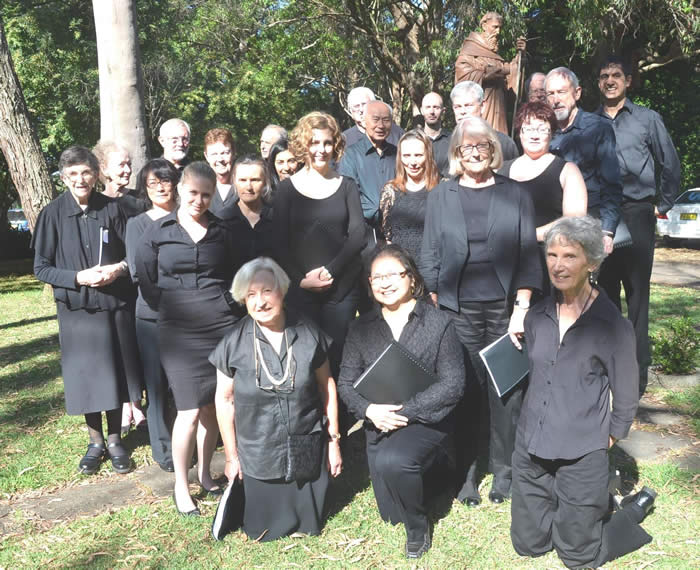
We welcome you and your friends to join us. Below is our group, watched over by StBenedict,
as we sang at Arcadia early in 2013.
Please consider joining the schola and being part of this great team.
Email [email protected] for more details or ring 8741 2341.
Rehearsals for 2017 take place on Thursdays from 6pm.
in the historic St. Bede’s Church, 43 Pyrmont St, Pyrmont.
Let us know beforehand if you are coming for the first time.
St Bede’s has limited…
Meanwhile consider joining the schola and being part of this great team.
Email [email protected] for more details.
Rehearsals from February 2014 will re-commence on Thursdays at 6.30pm.
in the historic St. Bede’s Church, 43 Pyrmont St, Pyrmont.
Let us know beforehand if you are first time coming.
St Bede’s has limited car spacing but ticketed street parking is available in Pyrmont.
For Public Transport either take Light Rail from the city to Star City station,
then a few minutes walk up Jones Bay Rd OR
Bus 443 from QVB, Yortk Street, Sydney, Stand B. Alight Harris St near John St Pyrmont OR
Bus 501 from Railway Square, George St, Stand D. Alight Harris St near Pyrmont Bridge.
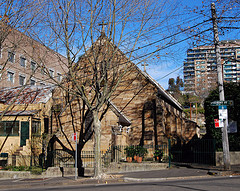
St Bede’s was completed in 1867. Most of the stone used was quarried locally
by voluntary Catholic stonecutters, masons, builders and labourers.
Below is the Gregorian Schola of Sydney after singing in St Bede’s in November 2012
The Sydney Morning Herald ofMay 14 1900 has the following
VISIT OF CARDINAL MORAN. “
“Yesterday morning Cardinal Moran paid a visit to St Bede’s Church, Pyrmont, for the purpose of pre-siding at the 11 o’clock mass and addressing the congregation in support of tile claims of St Mary’s Cathedral Building Fund. There was a crowded congregation, The Rev Dr O’Haran was the Celebrant of the mass. The Rev Father McIntyre (priest in charge) with the Rev Dr O’Haran, assisted at the sanctuary. The mass sung by the choir was Winter’s mass. Miss Byrnes presided at the organ. The Cardinal delivered an address, in which hee outlined the history of St Mary’s Cathedral and pointed out the praiseworthy efforts made to erect that building by his predecessors in office, Archbishop Polding and Dr Vaughan. Their present efforts to complete the building had met with a hearty response from the people of every parish. The large amount which they had been successful in raising was not made up from large contributions, but from small sums contributed by the working classes. A collection was then taken up, and a substantial amount raised.”
Gregorian Chant is sung in Latin. This language combined with ancient melodies allows an additional understanding and intimate experience of Liturgical verse.
Chant provides us the opportunity for shared prayer with those present today and a sense of special connection to our forebears.
As Vatican II stated: “The Church acknowledges Gregorian Chant as specially suited to the Roman liturgy, therefore, other things being equal, it should be given pride of place in liturgical services” Sacrosanctum Concilium 116. 1963.